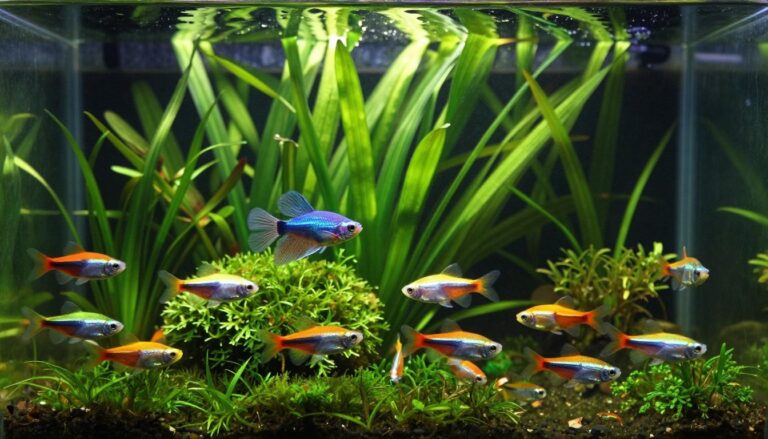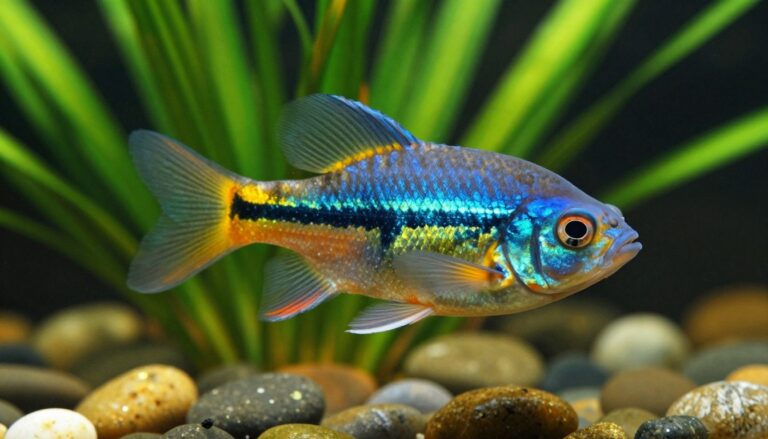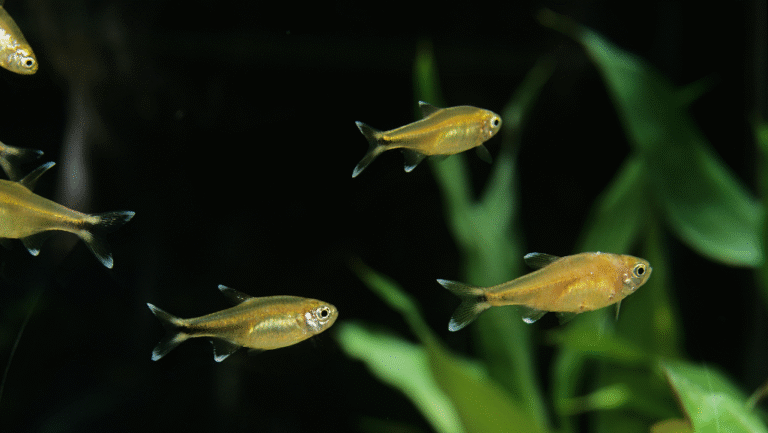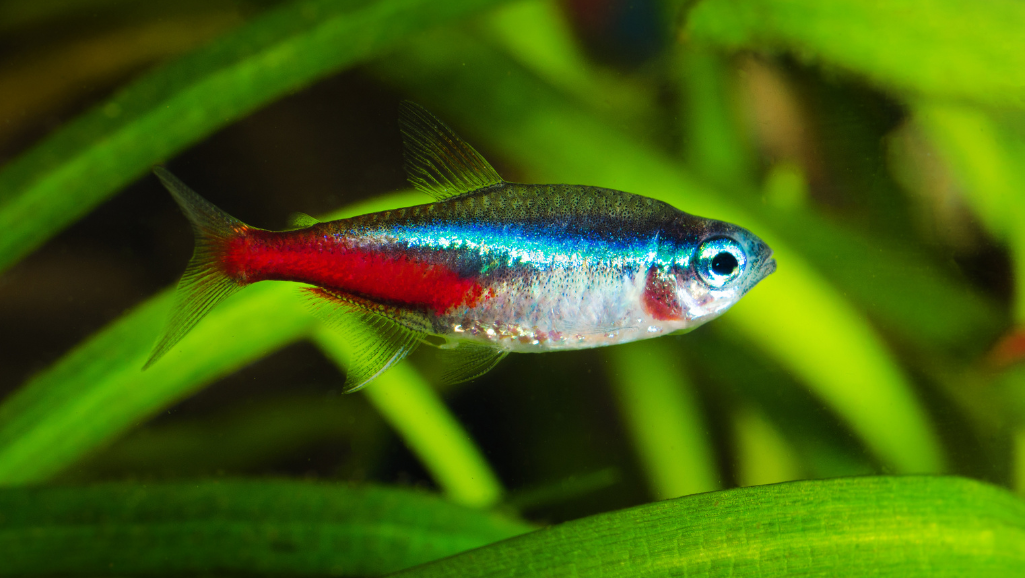
Meet the green neon tetra, a small schooling fish prized for a luminous turquoise-to-green lateral stripe that seems to shimmer with light and behavior. This striking species adds dynamic color to planted aquariums and works well in calm displays without overpowering carefully arranged layouts.
Native to tannin-stained headwaters in parts of Brazil, Colombia, and Venezuela, the green neon tetra prefers soft, slightly acidic water, dim lighting, and darker substrates that make its stripe stand out. In subdued, humic blackwater conditions the lateral stripe deepens and the fish displays its best color.
Expect a peaceful community member that favors gentle flow and mature tanks. This guide covers quick identification, ideal aquarium setup, feeding to enhance color, compatible companions, and straightforward breeding basics — read on to make sure your tank and care match this species’ needs.
Key Takeaways
- Distinctive blue-green stripe shifts with lighting and mood, creating visual interest in planted tanks.
- Best kept in soft, acidic, tannin-rich conditions with subdued lighting and dark substrate to amplify color.
- Peaceful, schooling behavior makes it an excellent addition to community aquariums when kept in appropriate groups.
- Stable, mature systems with gentle filtration help sensitive wild-caught specimens settle.
- Practical setup and feeding choices support long-term health and help the body color develop fully.
Green Neon Tetra Basics: Identification, Size, and Lifespan
Recognizing the essentials — stripe, size, and sex differences — sets you up for success with these small schooling fish.
Appearance and the iridescent blue-green stripe
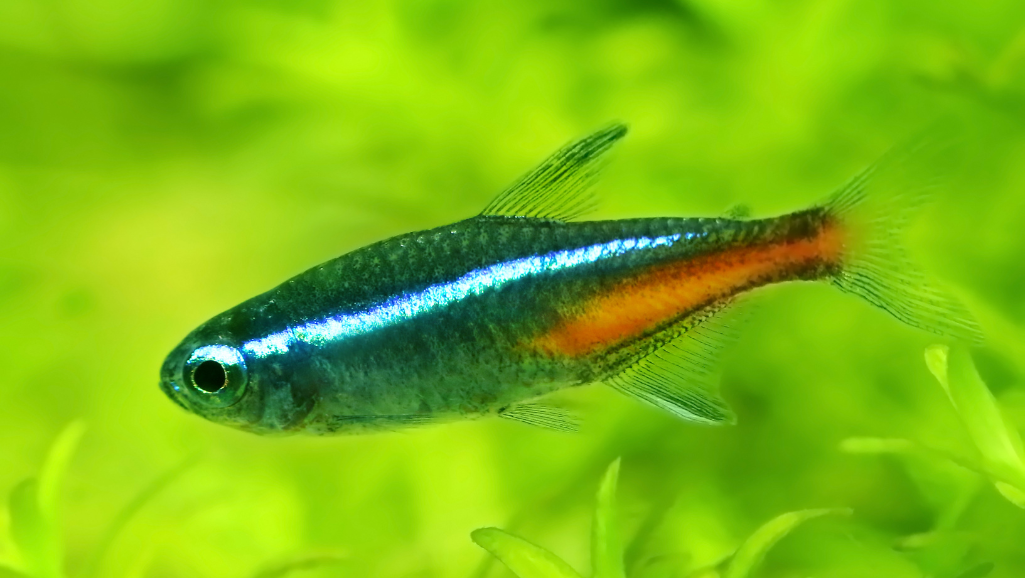
The most notable field mark is a narrow turquoise-to-blue-green lateral stripe (often brighter toward the head) that runs along the body of Paracheirodon simulans. Compared with related tetras the stripe leans greener and can cover more of the head and caudal base.
This stripe sometimes carries faint red accents below it, but the red is usually much reduced compared with neon or cardinal tetras. The stripe can appear darker or less reflective in low-light or when the fish is stressed — a practical cue sellers and hobbyists use when assessing condition.
Adult size and sexual dimorphism
Adults are small: typical size reported for green neon tetras ranges from about 1.0 to 1.5 inches (2.5–4 cm) depending on source and whether fish are wild-caught or captive-bred. Females usually appear a bit rounder-bodied, especially when carrying eggs, while males are slimmer and sometimes show a slightly more intense stripe.
Lifespan and wild-caught considerations
With steady care, captive-bred specimens commonly live around 3–5 years; wild-caught individuals may show shorter lifespans initially because of capture and transport stress. Stability in water chemistry, gentle filtration, and a calm, mature tank will significantly improve survival and long-term health.
Tip: Add green neon tetras to an established tank and acclimate slowly to avoid parameter shock; watch body condition and appetite in the first week.
- Identify Paracheirodon simulans by its greener, narrower stripe with reduced red below it.
- Plan stocking around an average adult size near 1–1.5 inches when determining school size and tank capacity.
- Use body shape — fuller-bodied females versus slimmer males — to help sort sexes before breeding or grouping.
Paracheirodon simulans vs. Neon and Cardinal Tetras
A close look at stripe length and red pigmentation quickly separates these three popular aquarium tetras.
Stripe and color are the fastest ID clues. Paracheirodon simulans (the green neon tetra) carries a narrower, greener turquoise stripe that typically extends farther forward on the head and often reaches the caudal base; red pigment beneath the stripe is usually faint or reduced compared with related species.
By contrast, the cardinal tetra shows a continuous, bold red stripe from eye to tail, while the classic neon tetra displays a red band that begins about mid-body rather than at the head. These differences are reliable visual markers when shopping or sorting fish in a tank.
Size at a glance: cardinal tetras are the largest (commonly near 2 inches), classic neon tetras average around 1.25–1.5 inches, and green neon tetras are the smallest of the three (roughly 1–1.5 inches depending on source and whether fish are wild-caught or captive-bred). Keep size variation in mind when planning nano tanks or larger schools.
- Decode shop names: fish labeled “false neon tetra” or “blue neon tetra” are often P. simulans—ask the vendor about origin and whether stock is wild-caught or captive-bred.
- Use stripe reach, head coverage, and red extent as quick field cues for identification.
- Remember small differences in pigment and size guide compatible schooling and biotope choices; when in doubt, ask for close-up photos or observe live behavior.
For a compact comparison and buying tips, see our detailed guide on green neon vs cardinal tetra.
How to Set Up the Aquarium for Green Neon Tetras
Plan a layout that supports natural behavior by creating a calm midwater lane framed with cover. While a 10-gallon tank can house a very small school, a larger tank (20+ gallons) is preferable for stable water and to keep 8–15 green neon tetras comfortably; bigger tanks make it easier to maintain steady parameters and let schools form natural groups.
Filtration and flow: choose gentle filtration—sponge filters are ideal for small, lightly stocked setups, and adding pre-filter sponges to HOB or canister intakes softens flow for tiny fish. Aim for slow to moderate circulation that won’t scatter the school or disturb leaf litter and plants.
Substrate and cover: use a dark, fine substrate to increase contrast and make the stripe pop. Add driftwood and leaf litter (Indian almond/catappa leaves) to release tannins and create hiding spots and microhabitats.
- Plant densely with low-to-medium light species (java fern/ Microsorum, Java moss/ Taxiphyllum, Cryptocoryne) and include floating vegetation to diffuse bright LEDs.
- Keep the central swim lane open, with wood, rocks, and plants along the sides and back so the school can move safely.
- Use a dark background, quiet equipment, and secure lids to reduce stress and prevent escapes.
Quick setup checklist (suggested): tank 20+ gallons for a stable school, sponge or gentle HOB filter with pre-filter, dark fine substrate, driftwood + catappa leaves, dense low-light planting, subdued lighting. These choices boost color, reduce stress, and create a true blackwater-inspired aquarium that lets green neon tetras shine.
Water Parameters and Blackwater Conditions

Keeping parameters steady is the best way to mirror the blackwater homes of this species. Recreate soft, humic waters and your simulans will stress less and show natural behavior.
Temperature targets and tolerance
Target 74–82°F (23–28°C) as a comfortable range for most home aquaria. Green neon tetras tolerate small fluctuations but do best with a reliable heater and gradual seasonal adjustments rather than sudden changes.
pH, hardness, and tannins
In the wild P. simulans inhabits acidic, tannin-stained streams with very soft to moderately soft water. For home tanks, aim for pH roughly 5.5–7.0 and general hardness (GH) on the lower side — roughly under 6 dGH (about 0–107 ppm, depending on local water chemistry). Stability is more important than exact numbers; gradual changes are far less stressful than wide swings.
- Use botanicals such as Indian almond (catappa) leaves, alder cones, and natural driftwood to add tannins and a gentle tea-colored tint that both calms fish and flatters stripe color.
- Avoid peat harvesting issues—source sustainable botanicals and prepare them by rinsing and simmering; replace leaves every 2–8 weeks as they break down depending on bioload.
- If your tap water is hard, blend RO water with a small portion of tap or use remineralizers to reach a soft, stable target rather than abrupt changes.
Do / Don’t (quick): Do prioritize a mature, cycled tank and slow acclimation; don’t add delicate wild-caught specimens to an immature system or flip lighting/flow suddenly.
Note: Wild-caught green neon tetras often need a longer, gentler acclimation period and benefit from a stable tank with established biofiltration. Make sure your tank is fully cycled and stable before introducing these sensitive fish.
Schooling, Behavior, and Community Compatibility

When kept in the right numbers, these small fish show true schooling choreography. Green neon tetras prefer the midwater lane and feel safest in groups; a calm, predictable aquarium environment encourages confident swimming and brighter coloration.
Ideal group size and midwater habits
Minimum: six individuals for very small displays; recommended: 8–15 or more to reduce shyness and unlock coordinated schooling behavior. In larger schools the group will form tighter schools and display natural turns and surges that are rewarding to watch.
Peaceful companions that work well
Good tankmates are peaceful, non‑predatory species that occupy other zones of the tank. Examples include Corydoras catfish (bottom dwellers), small rasboras, and a gentle centerpiece like honey gourami. Dwarf shrimp adults may coexist if there is dense planting and moss, but expect that tiny shrimp fry can be opportunistically eaten.
What to avoid in a mixed setup
Avoid larger or semi-aggressive species that will view small tetras as food or cause stress — for example, oscars, large cichlids, or aggressive barbs. Also avoid fin-nipping species that harass small, thin-bodied tetras. Arrange driftwood and planted cover to provide swim lanes and retreats so the school can shelter when threatened.
- Good mates: Corydoras, small rasboras, peaceful tetras, and small gouramis.
- Avoid: large cichlids, aggressive barbs, predatory catfish, and any species known to nip fins or chase small midwater fish.
- Stocking examples: 20-gallon tank — 10–12 green neon tetras + 4–6 Corydoras; 10-gallon tank — small school of 6–8 green neon tetras only (high maintenance to keep stable).
- Shrimp note: adult dwarf shrimp are usually safe, but provide dense moss and hiding places to improve fry survival.
Feeding Green Neon Tetras for Color and Health
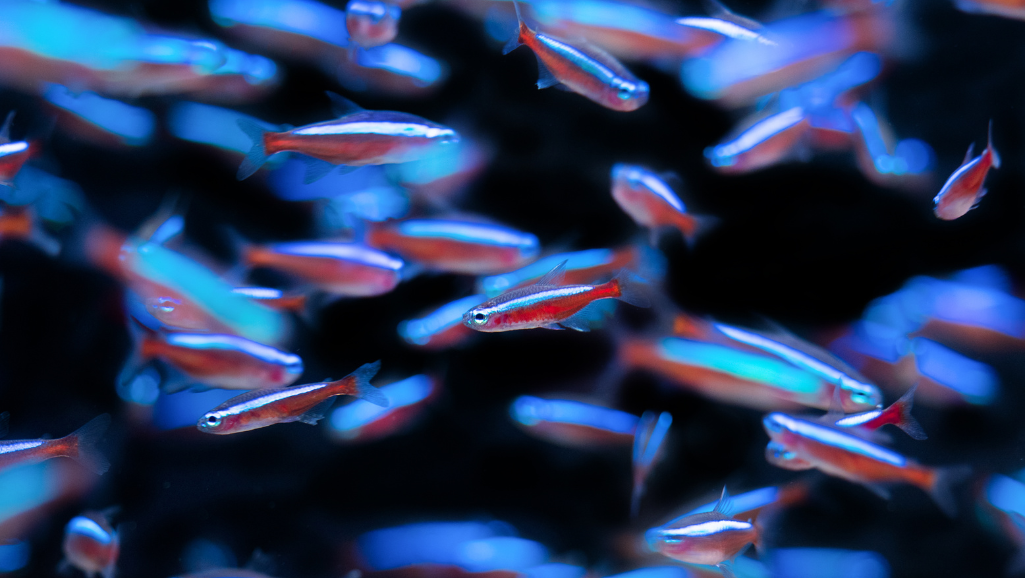
Offer a consistent, varied feeding plan to bring out the best health and shine in these small schooling fish. A predictable diet supports body condition and helps the stripe and overall color read brighter.
Daily staples should be quality micro flakes or micro pellets designed for small tropical fish — foods that crumble easily and match their tiny mouths.
These base foods provide steady nutrition and make daytime feeding simple and reliable while keeping maintenance manageable.
High-reward supplements
Rotate live or frozen treats such as baby brine shrimp, daphnia, and cyclops 1–3 times per week to add protein and stimulate natural foraging. Use freeze-dried options sparingly (e.g., tubifex) as occasional enrichment rather than a daily staple.
Frequency and portioning
Feed small meals multiple times per day rather than one large feeding. Offer an amount the school can finish within 60–90 seconds to prevent overfeeding and water-quality issues.
Distribute food across the midwater column so shy individuals and those in the middle of the school can access food without frantic competition.
- Daily routine: fine flakes or micro pellets once or twice daily.
- Rotate: supplement with live/frozen baby brine shrimp or daphnia 1–3x weekly.
- Observe: bright eyes, tight schooling, and prompt feeding are signs of good health.
Sample weekly schedule: daily micro pellets/flakes; Monday + Friday — frozen brine shrimp; Wednesday — daphnia or cyclops; weekend — light maintenance feeding only. Keep portioning conservative and perform small, regular water changes to manage nitrates and maintain clarity. With a balanced diet and careful portions, green neon tetras will develop better color, improved body condition, and long-term vitality in a calm planted aquarium.
Breeding Green Neon Tetras: A Step-by-Step How-To
Successful breeding begins with focused conditioning that increases egg production and stimulates courtship. Feed adults heavily for 2–3 weeks on live and frozen foods (daphnia, microworms, frozen baby brine shrimp). Short-term separation of males and females can sharpen spawning responses when reunited.
Conditioning and spawning setup
Assemble a dedicated, mature spawning tank of about 8–10 gallons with a gentle sponge filter. Use very soft, slightly acidic water (target pH 5.5–6.5 and GH near 0–4 dGH) made from RO or softened tap water; add tannin sources such as Indian almond (catappa) leaves and a bit of driftwood to mimic blackwater. Keep lighting dim and provide dense fine-leaved plants or Java moss as spawning substrate.
Egg protection and adult removal
Place an egg barrier (plastic mesh or egg crate wrapped in fine netting) elevated a few centimeters above the bare bottom so unfertilised eggs fall away from parents. Encourage spawning by introducing conditioned adults in the evening; remove adults the next morning to prevent egg predation.
Fry care and first foods
Green neon tetra eggs and newly hatched fry are light-sensitive — keep lighting subdued for the first several days. Begin feeding the fry infusoria, green water, or vinegar eels immediately after yolk-sac absorption (typically 2–4 days post-hatch). Feed tiny amounts often (4–6 times daily) and maintain pristine water with very small, frequent siphons or partial exchanges.
- Transition fry to live baby brine shrimp when mouthparts are large enough (usually 7–14 days depending on growth).
- Perform minimal, frequent water changes (1–5% daily or 10% every few days) to avoid stress—gentle siphoning near the outflow is safest.
- Monitor growth and be ready to sort larger juveniles to avoid competition as they develop.
Designing a Blackwater Biotope That Makes Colors Pop
Design choices—water color, plants, and wood—set the stage for luminous stripes. Recreate slow-to-moderate flow and overhanging riparian vegetation to echo natural river edges. Brown-stained water from humic substances softens contrasts and flatters small iridescent fish such as the green neon tetra.
Tannins, wood, and sustainable botanicals
Infuse your water with Indian almond (catappa) leaves, alder cones, and well-cured driftwood to develop the tea-stained glow of blackwater systems. These botanicals slowly release tannins that can calm fish and make stripe color read richer. Prepare botanicals by rinsing and briefly simmering to remove debris; add a handful of leaves or several cones to a planted tank and replace them as they break down (generally every 2–8 weeks depending on bioload).
Substrate, plants, and dim lighting
Choose a dark, fine substrate (dark sand or fine aquarium soil) to anchor plants and amplify iridescent glints. Favor shade-tolerant, low-to-medium light plants such as Java fern (Microsorum), Java moss (Taxiphyllum), and Cryptocoryne species; include floating species or fern fringes (e.g., Ceratopteris) to diffuse lighting and create soft shade.
- Materials & sources: buy sustainably harvested catappa leaves and alder cones from reputable suppliers; cure driftwood thoroughly (soak/boil) before adding.
- Initial setup: add a small layer of leaf litter (a few leaves per 10–20 gallons) and 1–3 alder cones to start tannin release; increase slowly to reach desired water tint without shocking fish.
- Substrate choice: dark sand or fine-grain planted substrate provides contrast and supports rooted plants.
- Maintenance: keep lighting subdued and flow gentle so the midwater lane remains calm for schooling; replace botanicals as they decompose and siphon leaf detritus during small water changes.
In a well-planned freshwater blackwater tank, restraint and natural materials create dramatic visual results: subtle brown tones and dense vegetation let the green neon tetras’ stripes glow like embers at dusk while supporting natural behavior and shrimp or fry refuges.
Buying, Acclimating, and Quarantining Green Neon Tetra
A smart purchase and gentle first days in quarantine set these delicate simulans up for success. Because many green neon tetras in the trade are wild-caught, make sure your display is fully cycled and stable before bringing any home. Prefer captive-bred stock when possible for hardier fish and longer-term survival.
Quarantine new arrivals in a separate 10–20 gallon hospital tank so you can observe and treat problems without risking the main display. Keep flow gentle, lights subdued, and feed tiny portions while watching appetite and behavior over several days.
Buying checklist
- Ask vendor: wild-caught or captive-bred? (captive-bred are usually easier to acclimate).
- Look for active schooling, clear eyes, intact fins, and a bright lateral stripe—avoid lethargic or heavily damaged fish.
- Buy from reputable shops that keep consistent water conditions and can confirm recent transport history.
Quarantine checklist
- Tank: 10–20 gallons with sponge filter (gentle flow) and dim lighting.
- Duration: observe at least 10–14 days; extend for wild-caught specimens.
- Feed small meals and monitor for signs: clamped fins, gasping, loss of color, or abnormal swimming.
Step-by-step acclimation
- Match vendor water in the bag when possible, floating the sealed bag to equalize temperature.
- Begin drip acclimation: start at about 1–2 drops/sec (or ~60–120 mL/hour) and double the volume added every 20–30 minutes until 3–4× the original bag volume has been added (generally 1–2 hours depending on flow). This gradual approach harmonizes pH and hardness and reduces shock.
- When parameters in the quarantine tank closely match the bag, net the fish gently and transfer to quarantine—avoid pouring bag water into the tank.
- Target parameters during quarantine: pH roughly 5.5–7.0, soft water preferred (GH low); temperature 74–82°F (23–28°C)—prioritize stability over hitting exact numbers immediately.
- Use observation rather than routine broad-spectrum medication; treat only when specific signs appear and under guidance.
- Move fish to the display during quiet hours and slowly mix display water if a minor parameter adjustment is needed.
With careful sourcing, deliberate acclimation, and calm quarantine care, your green neon tetras will settle more reliably and reward you with lively schooling and vivid color.
Conclusion
With calm water and a thoughtful layout, green neon tetras will repay patient care with steady schooling and a living shimmer. Recreate blackwater cues—dark substrate, driftwood, and botanicals—to let the lateral stripe read richer and to support natural behavior.
Keep schools generous, display tanks mature, and parameters steady to unlock confident behavior. Offer a varied diet that includes quality micro pellets or flakes as staples and small frozen or live items (baby brine shrimp are an excellent occasional treat) to build body condition and color.
Choose peaceful companions and provide dense planting or moss to protect tiny shrimp and fry from opportunistic predators. If you breed green neon tetras, plan for subdued light, an egg barrier, and microscopic first foods to give fry the best start.
With attentive, consistent care and time, your aquarium will show why this species remains a favorite for planted, blackwater-inspired tanks and calm freshwater displays.
FAQ
What is Paracheirodon simulans and how does it differ from related species?
How large do these fish grow and are males different from females?
What lifespan can I expect in home aquariums?
What tank size and group size work best?
What water parameters replicate blackwater conditions?
How important is aquarium lighting and planting?
What should I feed to maximize health and color?
Are they suitable for community tanks and which tank mates are safest?
How do I breed them successfully at home?
What are best practices for acclimation and quarantine?
How do I create a blackwater biotope that enhances color?
What filtration and flow are appropriate?
Can these fish live in nano tanks?